Specialist Hip Physiotherapist · Exeter · London · Online
Hip impingement that finally
gets the attention it deserves.
Femoroacetabular impingement — where the ball and socket of the hip don’t move freely, causing pain and reduced function.
Conservative physiotherapy-led management is the recommended first-line approach, backed by the latest clinical research.
In-person clinics in Exeter and Harley Street, London — plus online consultations available worldwide.
The goal isn’t just pain relief. It’s getting you back to the activities that matter — including high-level sport.
The Diagnosis
Understanding FAI types
FAI comes in three forms. Knowing which type you have shapes your management plan.
Type 01
An abnormal bump on the femoral head (ball) creates friction as the hip moves into flexion and rotation. Common in active individuals and athletes.
Type 02
The acetabulum (socket) has excessive coverage, causing the labrum to be pinched as the femur moves. More common in middle-aged, active women.
Type 03
Both cam and pincer morphologies present together. The most common presentation — roughly 70% of FAI cases.
Symptoms
Do you recognise these?
FAI symptoms are often misread, misdiagnosed, or dismissed. Here’s what to actually look for.
A sharp, catching feeling deep in the front of the hip or groin — triggered by hip flexion, squatting, or sitting in low seats.
Long periods sitting — driving, desk work, flights — load the hip in flexion. Getting up from a chair can be the worst moment.
Running, cycling, squatting, kicking — any sport demanding hip flexion under load tends to provoke it, during or hours afterwards.
Internal rotation in hip flexion is often limited. Deep squats, tying shoelaces, or crossing your leg over can all feel restricted.
Mechanical clicking or a sensation of the hip catching can indicate labral involvement alongside the FAI morphology.
FAI doesn’t always stay in the groin. Some people get lateral hip, buttock, or low back pain — which is why accurate assessment matters.
Setting the record straight
FAI myths worth busting
There’s a lot of noise out there about hip impingement. Let me be direct about what the evidence actually says.
Surgery has a role, but it is not the first-line answer for most people. The FASHIoN and FAIT trials showed no significant difference in outcomes between hip arthroscopy and physiotherapy-led care at one year. A well-structured conservative programme should be your starting point.
FAI morphology is incredibly common in asymptomatic people — including 50–70% of athletes. The scan finding alone means nothing without corresponding symptoms and clinical signs. Diagnosis requires all three.
Passive stretching into the direction of impingement can actually aggravate symptoms. The evidence points toward targeted strengthening, load management, and movement pattern retraining as the core of conservative management.
With a proper diagnosis, a clear understanding of what’s driving your symptoms, and a progressive loading programme, most people with FAI can return to the activities they love — including high-level sport.
Treatment Approach
Conservative management done right
The approach I use with FAI patients isn’t just a list of exercises. It’s a structured, phased programme that works with where you are right now.
Surgery should be a last resort, not the first conversation. And if you’ve already had surgery, a well-structured post-op programme is absolutely critical for good long-term outcomes.
Proper diagnosis, understanding your specific morphology, symptom drivers, and what’s actually limiting you day-to-day.
Not rest. Intelligent load management — reducing aggravating movements temporarily while we build capacity around them.
Hip flexor strength, glute control, adductor loading. Strength deficits are a key driver in FAI symptoms.
Gradually reintroducing the movements, activities and sports loads that matter to you. Confidence built on capacity.
Understanding your hip, knowing what keeps it happy, and having the tools to manage it yourself.
Learn From Me
Watch: FAI explained
Evidence-based, jargon-light. Everything you need to understand your hip.
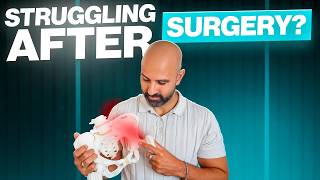
A full breakdown of the three types of FAI, what they mean, and what to do about them.
In-depth discussion on FAI, what I’d do differently post-op, and the importance of structured loading.

Is pelvic tilt actually causing your pain? What the evidence says about common misconceptions.
Online Programme
6 months. 5 phases. Zero surgery required.
A structured, app-based 24-week conservative management programme for FAI syndrome — designed by me for people who want to manage their hip without going under the knife.
Self-Directed
Expert-designed, condition-specific rehab programme you follow at home. Phase-based, 200+ exercises, built-in progress tracking.
Common Questions
Questions I get all the time
Ready to get a proper assessment?
Book an appointment in Exeter, Harley Street, or online. Let’s get clarity on what’s going on and build a plan.
Book an Appointment